
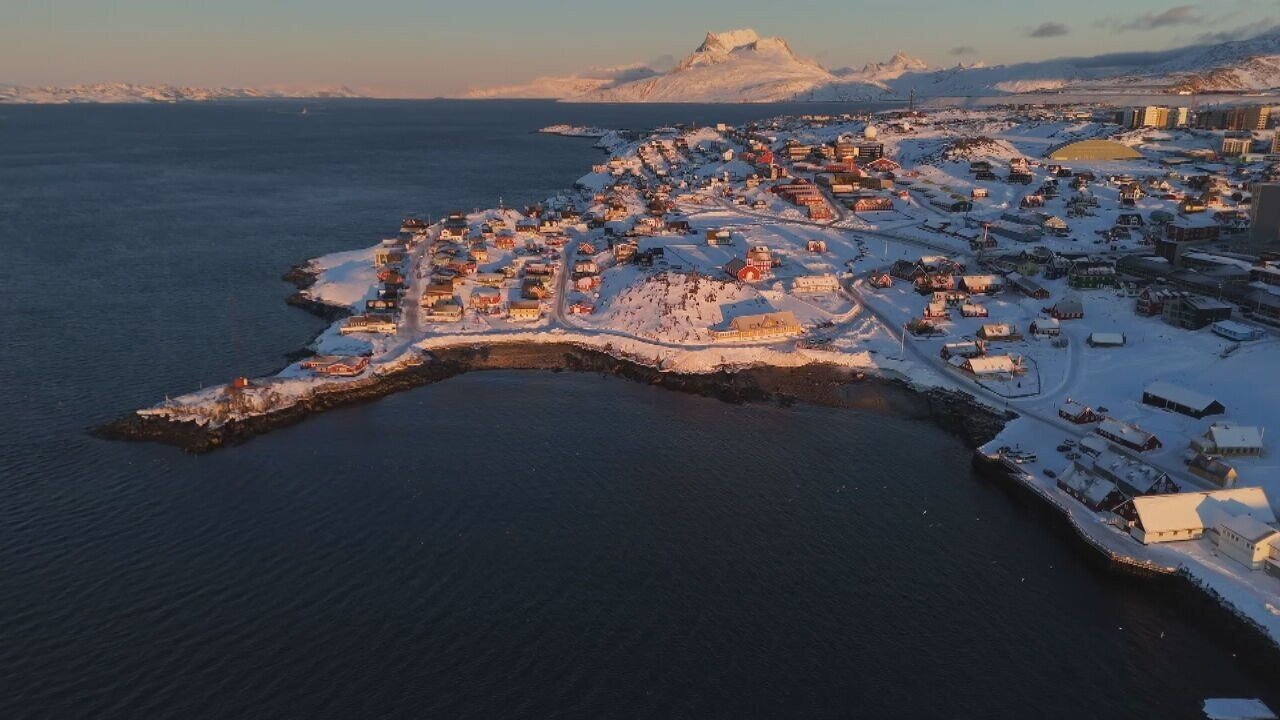
‘I want Greenland’: why Donald Trump wants to expand American presence in the Arctic American President Donald Trump wants Greenland for the United States — and even discussed the possibility of buying the island, which is part of the Kingdom of Denmark. ✅ Follow the g1 international news channel on WhatsApp Trump promised, in his inauguration speech, that “the United States will once again be considered a growing nation, increasing its wealth, expanding its territory” and also that it “takes our flag to new and beautiful horizons”. His words and his dream of incorporating the largest island in the world into his country recall other times in American history. Historian Walter A. McDougall, from the University of Pennsylvania, in the United States, told BBC News Mundo, the BBC’s Spanish-language service, that “Trump’s policies recall the tradition of the promised land of the Monroe Doctrine.” This doctrine, from 1823, served to justify the expansionist interventionism of the United States as legitimate actions against European meddling in the Western Hemisphere. Another historian, Jay Sexton, from the University of Missouri, also in the United States, highlights another parallel. “As with Greenland, Washington claimed it needed control of the territories before they fell into the hands of other powers.” In fact, the territorial expansion that transformed the United States into the vast country it is today began just a few years after its founding, in 1776. Wars of conquest, the submission of original peoples, the displacement of settlers and agreements with European powers were common means of growth for the emerging power. But the purchase of territories from other sovereign states, as Trump advocates in relation to Greenland, was another mechanism used by Washington leaders to expand the country’s territory. Map shows territories that the USA acquired in the last 250 years BBC Here are the episodes in which the United States purchased territories from other countries throughout its history. There were other occasions when Washington agreed to compensate foreign powers for the cession of territory. This is what happened with Spain in relation to Florida, in 1819. But these cases did not involve purchase and sale operations, per se. The Louisiana Purchase (1803) The decision taken by the third American president, Thomas Jefferson (1743-1826), to purchase the territory of Louisiana from Napoleonic France was the first major expansion of the new country. At that time, Napoleon Bonaparte (1769-1821) had already given up on his dream of forming an overseas empire for France, after the slave revolt in present-day Haiti. Therefore, he agreed to sell to the young American republic a vast and sparsely inhabited territory that no longer had strategic value. The general could then allocate the money from the sale to finance the expansion wars of his empire in Europe. The Louisiana Purchase represented the first major expansion of United States territory, just 27 years after its independence Getty Images Louisiana was, at the time, a much larger territory than the current state of the same name. And Jefferson saw the future of the United States in westward expansion. The president wanted to guarantee control of the Mississippi Valley and the strategic port of New Orleans, in the south of the country. Furthermore, it was his intention to eliminate the risk of French intervention in the American continent, something greatly feared at the time. The governments of the United States and France reached an agreement and Louisiana changed hands in November 1803. The Americans paid US$15 million for the territory, in values at the time. The enormous incorporation involved a territory that covered the entire area between the current states of Louisiana, to the south, and North Dakota and Montana, to the north. It represented the addition of more than 2 million square kilometers to the Union, which almost doubled its size. This is how the westward expansion of the United States began. The Mexican Cession (1848) In the 1840s, much of the American public was convinced that its “manifest destiny” was to expand westward until it reached the Pacific coast. The objective was eventually achieved at Mexico’s expense. Wars and purchases of territory made ‘Uncle Sam’ fat throughout history Getty Images One of the greatest defenders of expansion was American President James K. Polk (1795-1849). And, as soon as he arrived at the White House in 1845, he inherited the dispute with Mexico over control of Texas. The following year, after a clash between American and Mexican troops on the border, Polk managed to get the United States Congress to declare war on Mexico. But the causes of the conflict were deeper. “The United States had demonstrated its interest in California, which at the time belonged to Mexico,” explains Sexton. “It was one of the most economically vibrant regions in America and held the deep-water ports that were coveted for undertaking trade with Asia.” “But no Mexican government could accept selling California and intend to stay in power”, continues the historian. Victory in the war against Mexico in 1848 allowed the United States to expand its territory to the coast of its southern neighbor Getty Images The war ended with the American victory and the signing, in February 1848, of the Guadalupe Hidalgo Treaty, which granted the United States the territory of Texas, California, New Mexico, Arizona, Nevada, Utah and parts of Colorado, Wyoming, Kansas and Oklahoma. The United States paid $15 million, but, as Sexton says, “the Mexicans would never have agreed to cede the territories if they hadn’t lost the war. It was a forced sale.” Mexico lost more than half of the territory it held before the war. The defeat and the resulting territorial mutilation generated lasting national trauma for the country. The sale of La Mesilla (1853) A few years later, in 1853, Mexico agreed to sell a small strip of territory to the United States, which was south of the current American states of Arizona and New Mexico. The operation is known in Mexico as the La Mesilla Sale and in the United States as the Gadsden Purchase. It was the result of American interest in the construction of a transcontinental railroad and the difficulties of the Mexican government, which ended up accepting to receive US$10 million for the territory. Sexton explains that “slavers in the southern United States wanted a railroad that reached the Pacific and were afraid that the route would bypass the Rocky Mountains to the north, benefiting non-slaveholding states. Therefore, they promoted a railroad in the south that would lead to New Orleans.” The purchase of Alaska (1867) Many people did not understand why the then American Secretary of State, William Seward (1801-1872), devoted so much effort to purchasing the distant Arctic territory of Alaska from the government of Russian Tsar Alexander II (1818-1881) in 1867. Seward believed that Alaska had great strategic value, as it would remove the risk of British intervention in North America and allow the United States access to rich fishing regions in the Pacific Ocean. So he struck a deal with Russia to buy Alaska for $7.2 million. The purchase generated enormous controversy. Newspapers at the time even called the operation “Seward’s stupidity.” In the 19th century, the United States managed to buy an Arctic territory (Alaska), as Trump is now trying to do with Greenland Al Drago via Getty Images Tsarist Russia believed it had gotten rid of a territory of little value, whose administration was very expensive and which was considered vulnerable to a possible attack by the United Kingdom, its main rival at the time. Despite criticism, the American Congress ratified the purchase and sale treaty and Alaska became part of the United States. Decades later, the discovery of gold and large oil deposits, in addition to the military importance acquired by Alaska during the Cold War (1947-1991), rehabilitated Seward for his decision to purchase the territory. The purchase of the then Russian territory of Alaska in 1867 generated a lot of criticism in the United States Getty Images Purchase of the American Virgin Islands (1917) The last time the United States purchased a territory was from Denmark, which now does not want to sell Greenland to the Americans. The Danish West Indies, as they were known at the time, were a group of islands in the Caribbean, coveted by American strategists since the mid-19th century. A first failed attempt at negotiation also had Seward as a protagonist. An article by Danish historian Hans Christian Bjerg explains that, “after the American Civil War (1861-1865), the time had come to analyze strategic conditions in the Caribbean and Secretary of State Seward focused both on the annexation of Mexico and on a possible expansion of the United States in the Caribbean.” American strategists had a specific interest in the port on the island of Saint Thomas, due to the excellent natural protection offered by the local relief. Denmark spent decades exploiting large plantations on the islands, cultivated by enslaved African people. But the drop in sugar prices caused the European country to lose interest in the archipelago. A first purchase and sale agreement signed by the two governments in 1867 did not materialize because it was not ratified by the American Congress. The start of World War I (1914-1918) and the threat to the United States posed by German submarines reignited Washington’s interest. The Americans feared that Germany would invade Denmark and take control of the port of Saint Thomas. Astrid Andersen, from the Danish Institute of International Studies, told the BBC that “there are remnants of what we are hearing now with Greenland, because the United States has come to say ‘either you sell us out or we will invade’.” Ultimately, the two countries agreed to sell the islands to the United States for US$25 million. And as part of the agreement, the United States pledged not to oppose Denmark “extending its political and economic interests throughout Greenland.” Surveys indicate that the Greenlanders do not want their territory to be the subject of yet another of the negotiations that expanded the territory of the United States Sean Gallup via Getty Images * Map by Caroline Souza, from BBC News Mundo’s Visual Journalism team. VIDEOS: most watched on g1
Source link
5 territories purchased by the USA throughout its history
35

previous post