
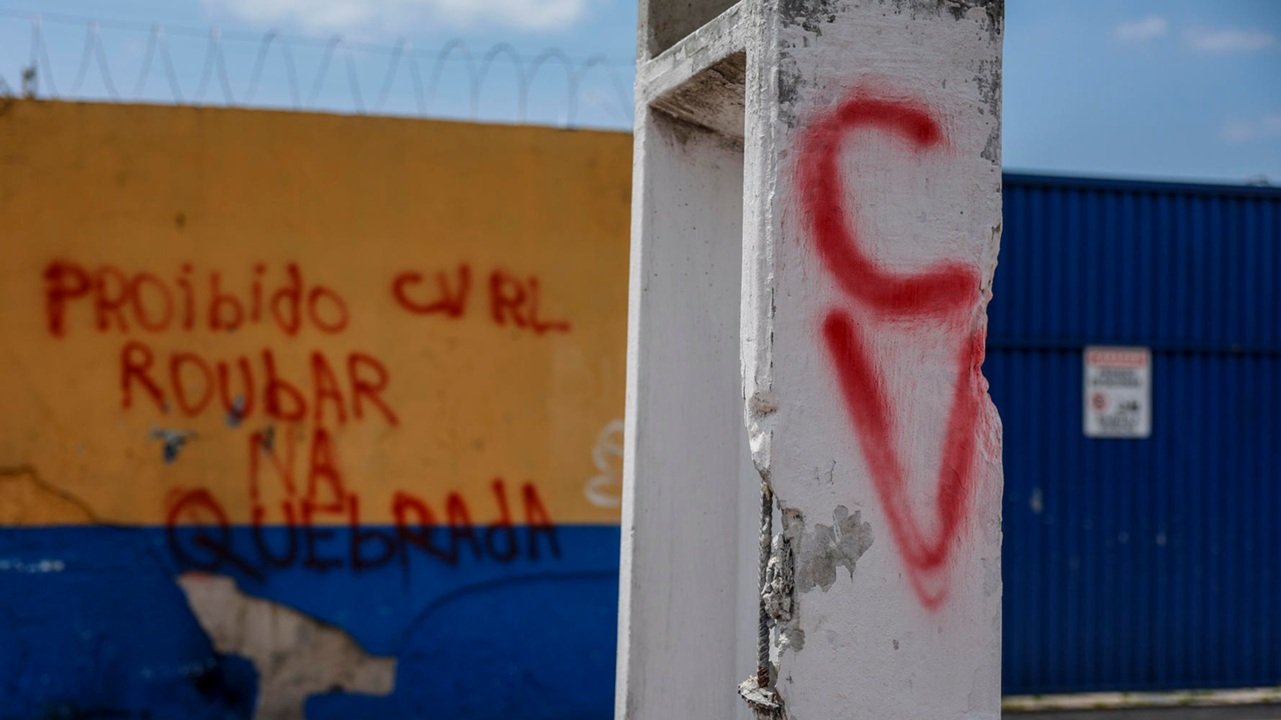
In the first week of November, the release of a video in which Uruguayan mega-drug trafficker Sebastián Marset (for whom the US is offering US$2 million for information leading to his capture or conviction) appears swearing loyalty to the Primeiro Comando da Capital (PCC) drew attention to the international connections of the São Paulo criminal group.
The video was released days after the Rio de Janeiro police mega-operation against the Red Command in the Penha and Alemão complexes, which ended with 113 prisoners and 121 people dead, four of them police officers.
Experts point out that the two Brazilian factions, designated as terrorist groups by Argentina and Paraguay, have ties to several criminal organizations in other countries, although the one created in São Paulo is more advanced in this process.
“Comando Vermelho does not yet have the international expansion that the PCC already has, but Comando Vermelho needs these routes to supply the domestic market and also to supply its international expansion, which is beginning, mainly as a wholesaler to other continents, something that the PCC already does”, stated Roberto Uchôa, member of the Board of Directors of the Brazilian Public Security Forum, in an interview with People’s Gazette.
The routes mentioned by the expert are the two main routes through which cocaine is transported through Brazil, the Rota do Solimões (which passes through the river of the same name) and the Rota Caipira (South and Southeast), whose dominance is sought by the two Brazilian factions.
Along this path, criminal organizations establish partnerships with factions in neighboring countries for supply purposes: Paraguay is a large supplier of marijuana and Bolivia, Peru and Colombia are the main cocaine producers in the world.
The PCC and Comando Vermelho have partnerships with Colombian guerrillas, such as the National Liberation Army (ELN) and dissent from the Revolutionary Armed Forces of Colombia (FARC).
In northern South America, another important partner of the PCC is the Venezuelan Tren de Aragua, which the US has linked to dictator Nicolás Maduro.
“Tren de Aragua is working with the PCC, both for drugs and weapons, mainly in Roraima, where there are a large number of Venezuelan refugees. Tren de Aragua took advantage of this to expand throughout South America, with this Venezuelan diaspora”, explained Uchôa.
Still in South America, investigations in Brazil highlighted links between the PCC and Hezbollah in the Triple Border, through which Lebanese terrorists supply weapons to the São Paulo criminal group and in return receive protection and can benefit from cocaine routes operated by the faction.
Regarding the Mexican cartels, Veja magazine revealed in 2022 that a document produced by the Brazilian Embassy in Mexico indicated links between the PCC and the feared Sinanola and Jalisco Nova Geração Cartel.
Although there is still no further information about this partnership, Uchôa speculated that it may be linked to synthetic drug trafficking and weapons exchanges, to which Mexican cartels have greater access than Brazilian factions.
“The Jalisco Nova Geração Cartel has already posted a video showing that it has [o lançador de mísseis] Javelin, used in the Ukraine war, is an American restricted weapon. You see that criminal organizations as a whole in recent years are connecting a lot more. Exchanging information, actions and business perspectives”, said the expert.
PCC leader was arrested in Mozambique
In Europe, the Calabrian ‘Ndrangheta mafia is its main ally in southern Italy, in addition to having partnerships with Spanish subgroups, the Balkan Mafia and the Albanian Mafia, to distribute drugs on the European market.
In West Africa, Brazilian factions have connections with criminal groups in Nigeria, Guinea and Angola, in a movement that has changed its characteristics, according to Uchôa.
“West Africa was important before only as a hub for Europe. Drugs were taken there, sometimes human trafficking networks that went up through the Sahel were taken advantage of and then it was crossed through the Mediterranean mainly to Spain, using superboats. They are very fast boats, they cross quickly [o mar]they release the drugs and when the police arrive, there is no one left”, said the expert.
However, Uchôa highlighted that, with economic growth in the region, West Africa has also become an important cocaine consumer market.
In the search for new markets, the PCC has already reached East Africa: in Mozambique, an important leader of the São Paulo faction, Gilberto Aparecido dos Santos, known as Fuminho, was arrested in 2020.
According to Uchôa, this movement exposes the search by Brazilian criminal groups to expand their businesses: the Public Ministry of São Paulo detected that the PCC is already present in at least 28 countries.
“The PCC, mainly, has invested in the growth of other markets, such as Asia and Oceania, because the price of cocaine there is stupidly higher than what it earns in Europe, for example. While in Europe it will sell for 30 thousand euros per kilo of cocaine, there it will sell for 90 thousand euros”, said the analyst, who highlighted that today drug trafficking is just one of the businesses maintained by the factions, which are also dedicated to illegal mining, selling gasoline and adulterated drinks and smuggling of cigarettes.
In this sense, Brazil will need to seek internal integration of its security forces and partnerships with other countries to contain the PCC and the Red Command.
“A problem that was regional, was a problem in Rio and São Paulo, became a national problem, then a problem in South America and now an intercontinental problem. And we need to understand this, that it is no longer a challenge just for Brazil”, said Uchôa.
“Brazil needs to take responsibility for combating these organizations and will need both internal and regional integration, in South America, and almost globally. It is no longer possible to work alone, to attack organizations that are in 28 countries”, he explained.
