
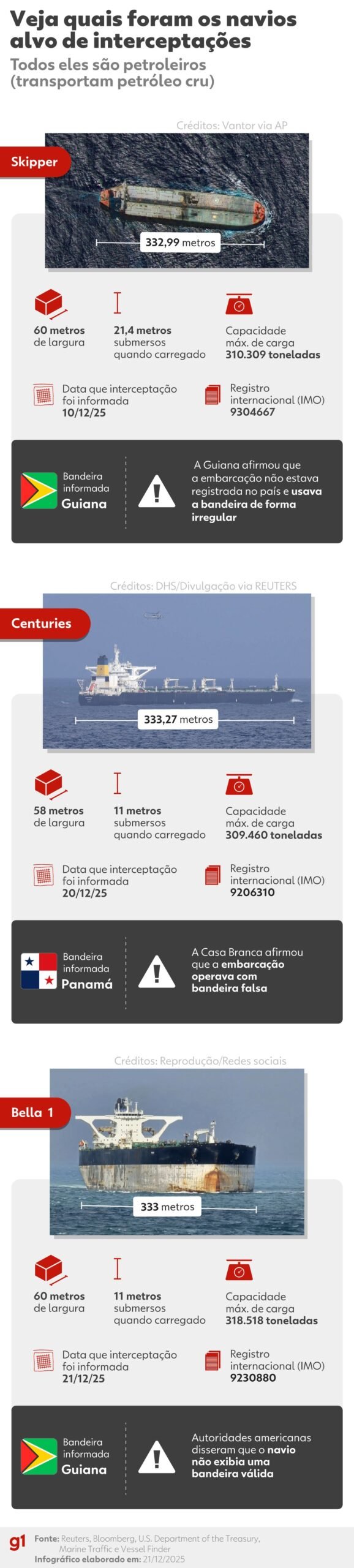
Reuters: US awaits reinforcement to board oil tanker The oil tanker linked to Venezuela that was surrounded by the Coast Guard last Sunday (21) has not yet been seized by the North American government. This Wednesday (24), the Reuters news agency reported that the US Coast Guard was still awaiting the arrival of additional forces to board and seize the Bella 1 ship. Furthermore, the Bloomberg agency, citing a source close to the operation, reported that the Bella 1 was not loaded with oil and sailed back to the Atlantic Ocean. The tanker is not expected to return to Venezuela. According to Bloomberg, the sanctioned oil tanker was initially boarded near Barbados, in the Caribbean Sea. Due to bad weather conditions, he was advised to proceed to calmer waters to be apprehended. A US official said that “the Coast Guard has not given up on seizing the tanker and that there is a court order of seizure for it.” A US official, speaking on condition of anonymity to Reuters, said the Coast Guard agents on the aircraft carrier Gerald Ford were from a Maritime Security Response Team and that at that time they were too far away from the Bella 1 to conduct a boarding operation. The pursuit of the Bella 1 shows the “mismatch between the Trump administration’s desire to seize sanctioned oil tankers near Venezuela and the limited resources of the agency that primarily conducts the operations, the Coast Guard,” says Reuters. In recent weeks, the Coast Guard seized two oil tankers near Venezuela, increasing the Trump administration’s pressure on Nicolás Maduro. On Wednesday (24), Reuters also reported that the White House ordered US military forces to focus almost exclusively on placing Venezuela in a state of “quarantine.” The official, speaking on condition of anonymity, said the White House order was for U.S. forces to focus almost exclusively “on quarantining Venezuelan oil for at least the next two months.” Why are ships being seized? Venezuela has the largest proven oil reserves on the planet, with a capacity of approximately 303 billion barrels — or 17% of the known volume —, according to the Energy Information Administration (EIA), the official US energy statistics body. 🔎 In practice, the potential is enormous, but it remains underutilized due to precarious infrastructure and international sanctions that limit operations and access to capital. This volume puts the country ahead of giants such as Saudi Arabia (267 billion) and Iran (209 billion), by a wide margin. Much of Venezuela’s oil, however, is extra-heavy, which requires sophisticated technology and high investments for extraction. There is a clear US interest. According to the EIA, Venezuela’s heavy crude “is well suited to North American refineries, especially those located along the Gulf Coast.” In this context, the Republican achieves two objectives simultaneously: by seeking to favor the US economy, he also puts pressure on Venezuela’s oil production and exports — a sector that is central to the country’s economy and supports the government of Nicolás Maduro. The initial effects began to appear last week. A Bloomberg News report indicated that Caracas faces a lack of capacity to store oil, amid measures by Washington to prevent vessels from docking or leaving Venezuelan ports. Since the United States imposed sanctions on Venezuela’s energy sector in 2019, traders and refiners that buy Venezuelan oil have resorted to using a “ghost fleet” of tankers, which hide their location, and vessels sanctioned for transporting oil from Iran or Russia. China is the biggest buyer of Venezuelan crude oil, which accounts for about 4% of its imports. In December, shipments are expected to reach an average of more than 600,000 barrels per day, according to analysts consulted by Reuters. For now, the oil market is well supplied, and there are millions of barrels in tankers off the coast of China waiting to be unloaded. If the embargo remains in place for some time, the loss of nearly a million barrels per day in crude oil supply is likely to put upward pressure on oil prices. The attack on oil tankers comes as Trump has ordered the Defense Department to carry out a series of attacks on vessels in the Caribbean and Pacific Ocean that his administration alleges are smuggling fentanyl and other illegal drugs into the United States and beyond. At least 104 people have been killed in 28 known attacks since the beginning of September. White House chief of staff Susie Wiles said in an interview with Vanity Fair that Trump “wants to keep blowing up boats until Maduro shouts ‘uncle.'” See which ships were intercepted. Art/g1 – Bruna Azevedo
Source link
US still trying to seize third oil tanker linked to Venezuela
58
