
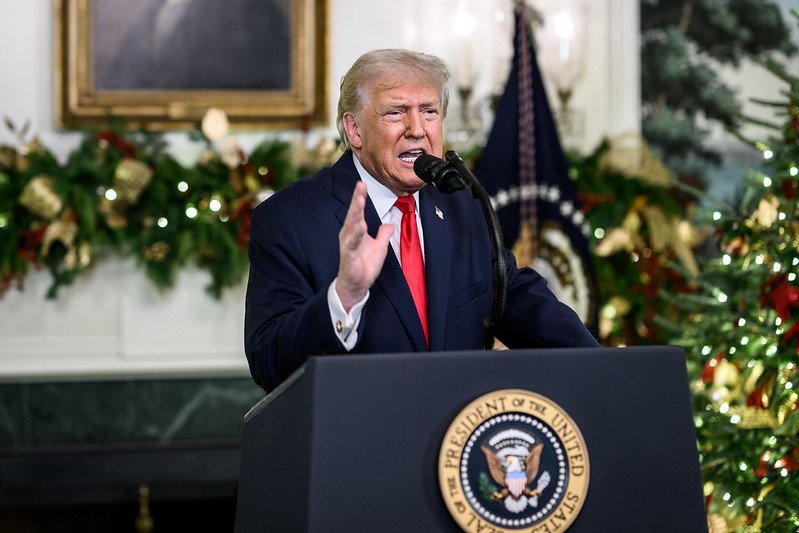
The President of the United States, Donald Trump, signed a decree that sets the goal of sending astronauts to the Moon by 2028. The measure changes the priorities of the American space program amid the dispute with China.
With the new guideline, NASA begins to focus its efforts on returning to the Moon. At the same time, manned missions to Mars are no longer the central objective in the short term.
According to the government, the decision represents a strategic change in the country’s space policy. The text of the decree points out that the return to the Moon reinforces the technological leadership of the United States.
Furthermore, the government assesses that the initiative could open the way for economic activities beyond Earth. The expectation is to stimulate innovation and development in the space sector.
In this context, the plan foresees the installation of a permanent structure on the Moon. The official projection is to begin, by 2030, the assembly of an outpost on the natural satellite.
In addition to manned landing, the decree confirms the use of nuclear reactors. This equipment must be installed on the lunar surface and also in orbit.
With this, the government seeks to guarantee a continuous supply of energy for long-term missions. The measurement is considered essential for more complex scientific operations.
At the same time, the decision increases the pressure on NASA. Private companies in the space sector must also play a central role in meeting the schedule.
Meanwhile, China moves forward with its own plans. The country announced its intention to send astronauts to the Moon by 2030.
Finally, the White House states that anticipating the return to the Moon is strategic. According to the government, the measure responds directly to Chinese advances in the space sector.
