
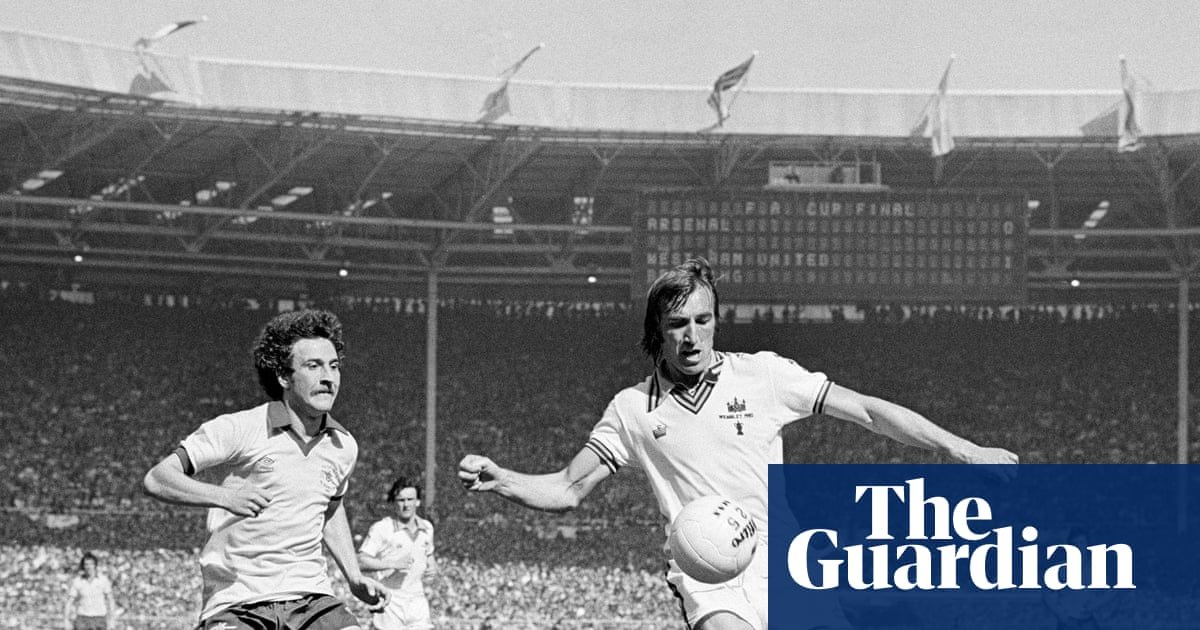
The footballer Billy Bonds, who has died aged 79, captained West Ham to two FA Cup final victories – in 1975 and 1980 – during a 21-year period at Upton Park in which he made a club record 799 appearances.
Voted by the fans as West Ham’s greatest ever player, ahead even of Bobby Moore, he also skippered the team to the finals of the European Cup Winners’ Cup in 1976 and the League Cup in 1981, although on both occasions on the losing side.
On the terraces the home fans sang that he had “eyes of blue” and was “six foot two”, even if he was actually only 6ft – an indication, perhaps, of how his fierce determination and inspirational leadership qualities seemed to raise his stature above the norm.
The supporters loved him for his brave, wholehearted commitment, as well as for the intelligence and skill he displayed as a defender and midfielder – and were bemused that he never played for England. After he retired from playing in his early 40s his association with West Ham extended into backroom duties, initially as a coach and then over a four-year spell as manager.
That association began in 1967, when the West Ham manager Ron Greenwood took him from his local club, Charlton Athletic, for a fee of £47,500 to join a team featuring the World Cup winners Moore, Geoff Hurst and Martin Peters.
Initially playing at right-back, Bonds was fairly soon moved into midfield to work in closer attendance with his friend Trevor Brooking, finishing the 1973-74 season as the club’s top scorer with 13 goals, level with the striker Clyde Best. In early 1974 Moore left for Fulham, and Bonds took over the captaincy.
The following year he found himself up against Moore as West Ham met Fulham in the 1975 FA Cup final. Having nursed himself through most of the season with a troublesome groin strain, by his own estimation he was only 75% fit for the match, but he showed little evidence of discomfort as West Ham won 2-0 with a pair of second-half goals from Alan Taylor. In the subsequent European Cup Winners’ Cup campaign in 1975-76, Bonds led his side all the way to the final before they lost 4-2 to Anderlecht, who benefited from playing in their home city of Brussels.
In the league, however, West Ham were not nearly so assured, and after three seasons flirting with relegation they dropped out of the First Division in 1978. It took three campaigns to get back up, but in the meantime, in 1980, Bonds lifted another trophy as they achieved the rare feat of winning the FA Cup from outside the top flight, beating First Division Arsenal 1-0 with a headed goal from Brooking. Bonds should really have missed that Wembley match on suspension, as he had been sent off in a league encounter not long beforehand, but the FA were persuaded to postpone his punishment until after the final.
In 1981 he led West Ham back into the First Division, lost out narrowly on another trophy thanks to a 2-1 defeat to Liverpool in the League Cup final, and finally, at the age of 35, received his first international call-up, for a post-season friendly against Brazil. However, in the final match of the league campaign he broke two ribs in a collision with his own goalkeeper, Phil Parkes, and had to relinquish his England place. Another chance never came his way.
Born in Woolwich, south-east London, to Arthur, a bus mechanic, and his wife, Barbara, Billy had a brother, Michael, and a sister, Linda. After leaving Eltham Green school at 15 he worked on the shop floor of a ship propeller factory before joining the ground staff of Charlton Athletic. He made his first team debut in defence for Charlton in the Second Division in 1965, aged 18, and soon became a regular, appearing 95 times in the league before moving to West Ham.
Bonds made a decision to retire in 1984, but the then manager John Lyall convinced him to carry on as a stopgap player, and he featured with distinction in another 74 matches over the next four seasons before finally calling it a day at the age of 41 in 1988; he was made MBE the same year.
He moved straight into being West Ham’s youth team coach, and two years later was appointed overall club manager after the resignation of Lou Macari. Bonds secured promotion to the First Division at the end of his first full season in charge, after which West Ham went back down to the Second Division in 1992 and then up again in 1993 – into what had now become the Premier League. Following a respectable enough 13th-place finish in 1993-94, he resigned when the club’s owners offered him a directorship, so that, Bonds claimed, they could put his assistant, Harry Redknapp, into the manager’s seat.
Periods of coaching at Queens Park Rangers and Reading led to another managerial job in 1997, this time at Second Division Millwall, but he was sacked the following year after 53 matches in charge. Afterwards he moved into quiet retirement in Kent, where he was a keen gardener, and at a holiday home in Dorset, where he could indulge his interest in the life and works of Thomas Hardy. In 2019 the east end of West Ham’s London Stadium was renamed the Billy Bonds Stand.
Throughout his career Bonds was known as a humble family man, always keen to get back home as soon as possible after a match to be with his wife, Marilyn, whom he married in 1971, and their two daughters, Claire and Katie.
Marilyn died in 2020. He is survived by his children and by two granddaughters.
